
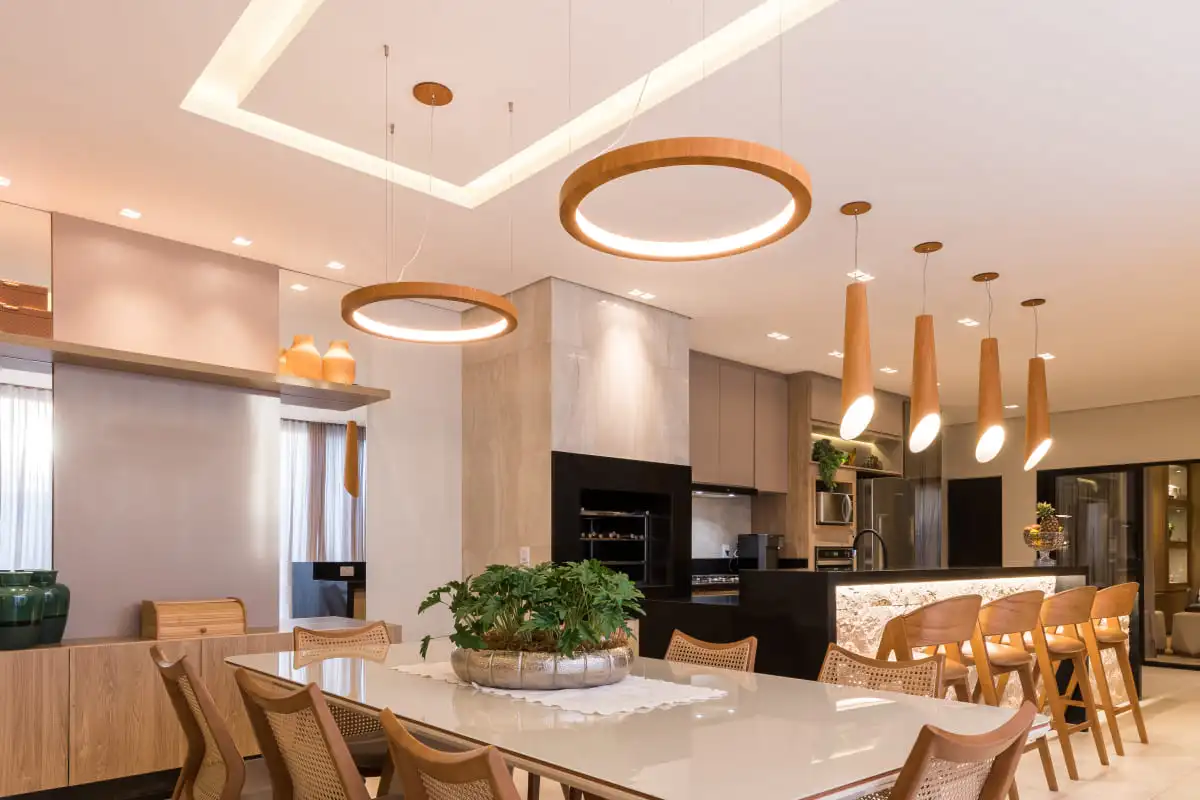
How can pendant lights add value to decoration?
Some pendants carry an indisputable aesthetic beauty and stand out in the environment, configuring true works of art.
Combined with the fact that this object is usually in a prominent place in the space, arranged above the table or some point to which attention is drawn, they can transform the decoration of environments.
Simpler or minimalist decorations, for example, can receive a pendant with more details, which guarantees greater sophistication and balance in the final composition.
But do you know the best places to arrange these pieces? Below, we suggest some ideas for composing spaces with the pendant.
Arch. Sara Bevilaqua Hister/ Photo Michel Correa
Where to use pendants in decoration?
Pendants can be arranged in different ways in interior design projects. Check out some examples:
Reading light
One possibility for using the pendant is to create different environments in the same space. In this sense, it can be used to demarcate a reading corner in the bedroom or even in the living room, for example.
Ideally, the lighting should be arranged at a height of about 50 cm from the book, with an intermediate intensity. Thus, it is not so strong that it bothers the eyes and not so weak that it makes reading impossible.
Opt for pendant models with sizes proportional to the area of your reading space. They must guarantee directed lighting, in this case downlight, and avoid casting shadows that hinder the moment of concentration.
Corner lighting
Corner lighting can be used for different purposes. For it to be effective, it is necessary to understand your needs and what kind of activity will be carried out there.
Some tips related to the reading corner can also be useful for this case. Among them, opt for pendant sizes proportional to the area you intend to highlight.
Finally, consider the functionality of this space. Will it be a resting corner? For studying? Or will it work to highlight some special object of your decoration?
General lighting
Despite being very efficient in illuminating objects or even delimiting environments in the same space, pendants are also widely used for the general lighting of a context.
When it has this purpose, there is a need to distribute the light over a wide area. This can be accomplished using a hollow or translucent dome so that the light propagation is greater.
Another possibility is to combine different smaller luminaires that illuminate specific points in the room.
Dining table lighting
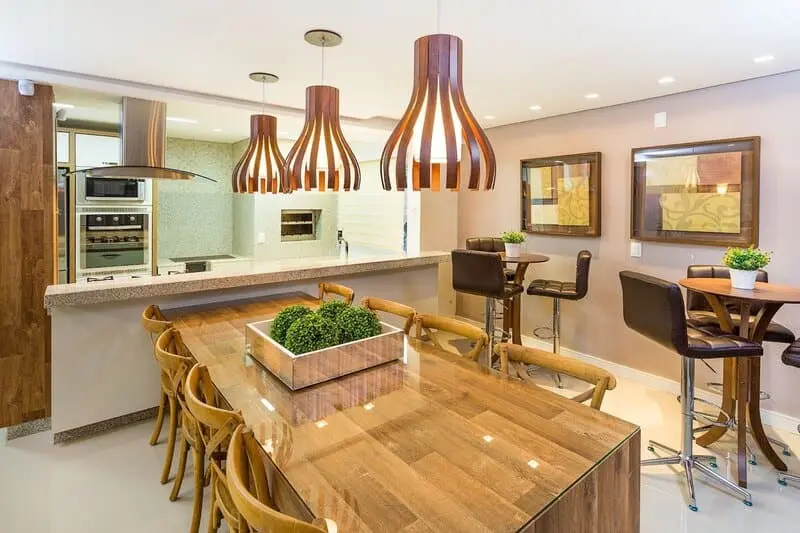
In this classic case, the function of the pendant is to illuminate the dining table, an important gathering space in the house.
For the light to reach this object, it is important that the luminaire is aligned with it, and not with the dining room. Therefore, consider where the furniture will be arranged before starting the installation.
It is also necessary to consider the size of the table and its shape. On round and smaller tables, one pendant may be enough.
On rectangular and larger ones, you will likely have to use more than one pendant. Another possibility is to opt for a larger, elongated pendant, such as the Accord Flow pendant.
Kitchen counter lighting
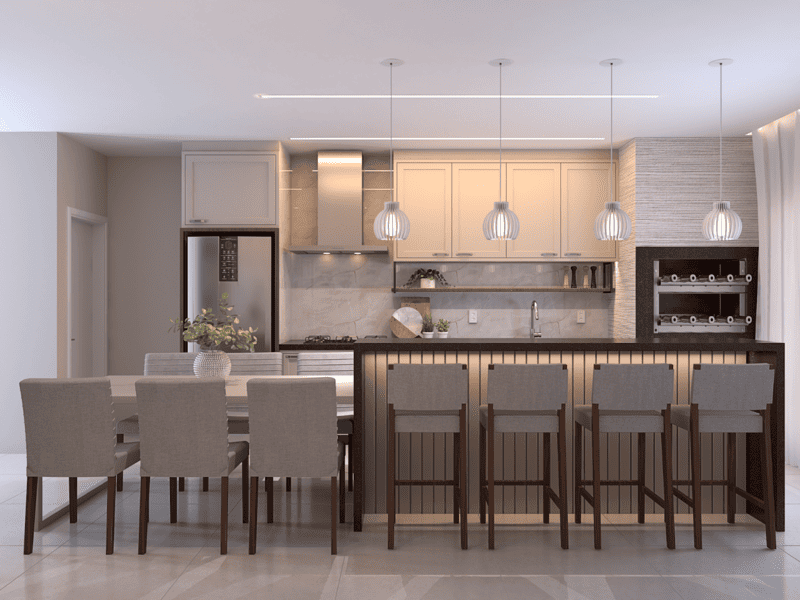
The pendant light can also be arranged over the kitchen counter, highlighting this point of the environment.
Care must be taken so that the luminaire is not installed in a way that the light falls directly on the face of the user sitting at the counter, but rather downwards.
The number of pendants needed can vary according to the size of the counter and the room. In smaller kitchens, it is advisable to use pendants proportional to the context.
Finally, also consider models that are easy to clean and maintain, since this environment usually accumulates dirt and grease from food, and needs to be cleaned more frequently.
Arch. Jéssica Schervinski
What is the ideal height to install the pendant?
The height of the luminaire depends on where it is placed. On the dining table, for example, it is recommended that it be at a distance of 140 to 150 cm between the floor and the pendant, or 70 to 90 cm between the pendant and the tabletop.
In the living room, ideally there should be 150 to 170 cm between the dome and the coffee table, or 30 to 50 cm between the dome and the side table.
In the kitchen, in turn, it should be at a distance of 200 cm between the luminaire and the sink or support table or, in the case of a dining table in the room, this distance should be 70 to 100 cm from the pendant.
The pendant can also be arranged in the bedroom, usually above the nightstand. In this case, the distance from the furniture to the luminaire should be 30 to 50 cm.
Finally, in hallways and free areas, it is recommended to maintain a distance of 200 to 210 cm between the dome and the floor.
It is important to emphasize that these tips are a base reference, not a definitive rule. The flow of people in the environment, the functionalities of the space, the visual axes, and other composition elements must be evaluated before installing the pendants.
Tips for choosing and decorating the environment using a pendant light
Are you interested in adopting the pendant in your decoration project? Check out some tips and use this type of luminaire in the best possible way!
Analyze the function of the pendant in the environment
The first step to using the pendant in your project is understanding what the goal of this luminaire is in the environment where it will be used.
It can, for example, illuminate the entire space, demarcate a reading corner in the bedroom, or illuminate the dining table.
These factors affect the best type of pendant to be used, as well as the way it should be arranged.
In pendants that propose to illuminate an entire room, for example, it is common to use a translucent dome, which allows the light to spread through the space.
If, on the other hand, it fulfills the role of illuminating a reading corner, a closed dome model, downlight, may be more appropriate. This model offers more focused lighting, which allows for more detail when performing tasks. The Accord Conical pendant can be a good option.
There is also the possibility of using the pendant to highlight some furniture or object, as happens on the dining table. In this case, consider more closed or directed models.
Define the style of the pendant
It is important that the design of the pendant is in harmony with the type of decoration adopted in the project.
For this, consider not only the decoration style adopted, but also the emphasis you want to give to this object in the composition of that environment.
Choose the most appropriate color temperature
When the type of pendant and its arrangement in space are already defined, it is also necessary to decide the color temperature of the light source.
This is a very important factor in the lighting design of an environment, since different color temperatures can provide different sensations to people who frequent a space.
The lamp with white light, or higher color temperature, is widely used in more functional environments, such as offices.
Yellow light, or lower color temperature, on the other hand, is more welcoming and provides a more comfortable environment. Therefore, it is more recommended for long-stay and resting environments, such as bedrooms or the living room.
Ensure the alignment of the luminaire
Despite the qualities mentioned above, the pendant must be well positioned in the environment to ensure its efficiency.
This means ensuring that it is aligned with the place where it is placed and with its purpose in the project.
Therefore, if you are going to place it over a dining table, the pendant must be above this object. The same applies to a reading corner, the kitchen counter, or other types of lighting.
Discover Accord's wooden pendants!
For over 25 years, Accord has been working with sophisticated and contemporary designs of decorative wooden lighting fixtures. They are unique models, handcrafted, that tell a story.
In addition, you can request the customization of your luminaire. Both the color of some products can be adjusted according to the customer's preference and their size, as well as the cable length of the pendants.
Discover the Accord pendant models, which combine craftsmanship techniques with the highest technology and make your project even more special!
Comments (0)
No comments yet. Be the first to share your thoughts!
Leave your comment
Your email will not be published. All comments are moderated before being posted.


