
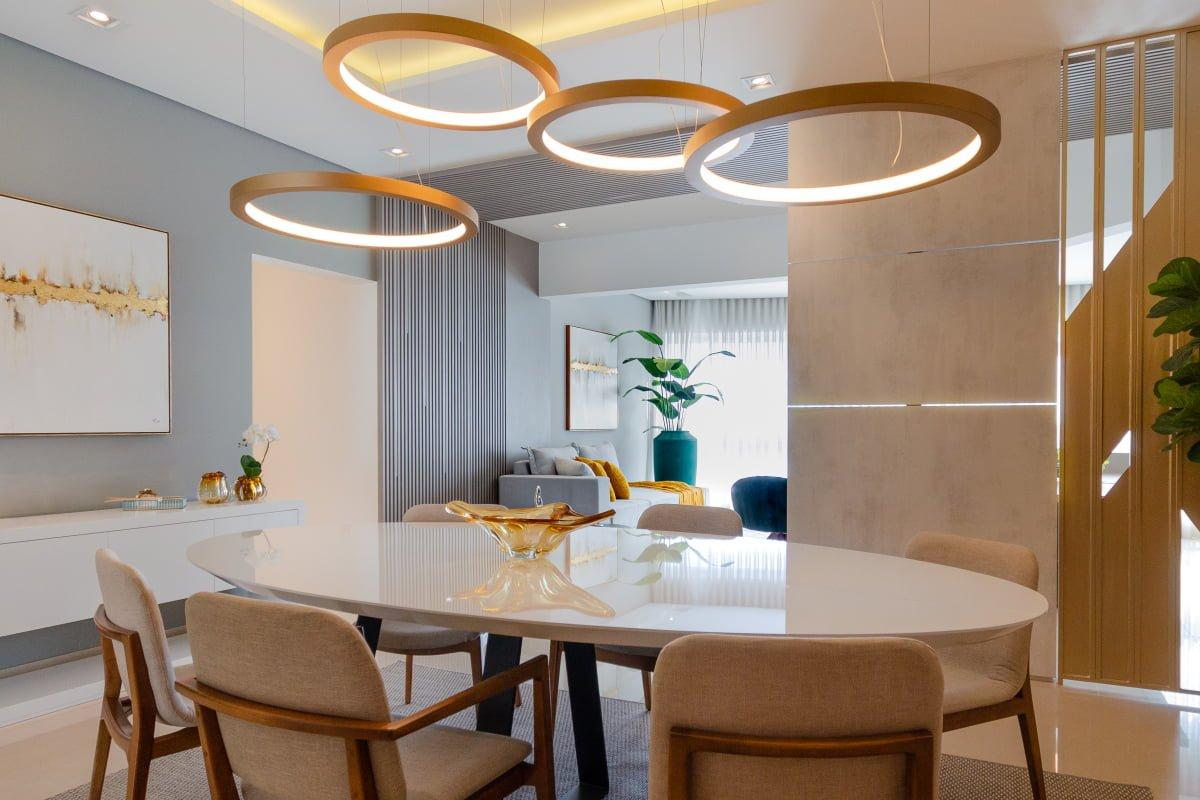
The light that surrounds us is powerful: it is capable of generating sensations like focus or relaxation, of highlighting objects and hiding others. In a decoration project, the lighting can provide well-being and serve the functionality of an environment.
But, for this, it is necessary to understand how to handle it: knowing what are the indicated types of lamps and luminaires for each use, the possible color temperatures and, especially, for what purpose these elements will serve in each room of the house.
Want to know more about these characteristics? Check out this complete guide, made to make your lighting project even better!
What is the importance of a well-structured lighting project?
Lighting is more important in the decoration project than most people believe. It affects feelings and even behaviors in certain spaces.
Both natural and artificial light can help create an atmosphere of coziness or concentration, highlight points and objects in the house, or even separate environments within the same area.
In this sense, a good lighting project is, above all, functional. In it, the light must fulfill the objectives of a certain space, whether to highlight an object or create a reading space, for example.
Therefore, in corporate spaces, lighting must contribute to making people more productive and focused. In homes, each environment has its specificity. While the kitchen needs to be more functional, the bedroom is a place of rest, and calls for more comfort and intimacy.
These sensations can – and should – be transmitted with a well-crafted lighting project. For this, it is necessary to consider the type of luminaire that best meets your needs, in addition to the lamp's color temperature that makes the most sense for your project and other factors described below.
What is the best type of lamp?
The lamp choice can make a huge difference in the well-being and functionality of the environment. Discover the most recommended ones for your project:
Incandescent lamp
This is the oldest type of lamp, the one that has a filament in a glass bulb and produces a yellowish, diffused light.
Although widely known, its manufacture and import have been ended in Brazil since 2014 and, since then, the search for LED lamps has increased considerably.
This is because incandescent lamps have high energy consumption and low efficiency. Their lifespan is extremely short, about 750 hours, making this type of lamp uneconomical and unsustainable.
Fluorescent lamp
The fluorescent lamp consists of a glass tube covered with phosphorus-based material and inert gases and functions as a ballast. The light it produces is considered cool, with a higher color temperature.
Its consumption is low and its efficiency is good, especially compared to the incandescent lamp: the lifespan of the fluorescent lamp can vary between 3,000 and 20,000 hours.
The problem with this type of lamp lies in its disposal, since the gases present inside are extremely toxic to people and the environment.
LED lamp
The LED lamp is, without a doubt, the most economical. It works from a diode that emits light when forward-biased.
This type of lamp has low consumption, good luminous efficiency, and a lifespan that can reach up to 40,000 hours.
Furthermore, it contains no polluting gases and has a recyclable use of up to 98% of its composition.
For those who desire a more retro design, some LED lamp models even imitate the famous incandescent lamps.
Halogen lamp
Similar to the incandescent lamp, the halogen is also composed of a filament in a glass or quartz bulb. The difference is that it has an internal gas, which makes it produce more brightness.
It has high consumption, high luminous efficiency, and a lifespan of about 2,000 hours, significantly superior to the incandescent and inferior to the LED. Generally, it is used in decorative residential lighting, as it brings a more rustic feel to the environment.
What is the most suitable lamp model?
Powerful, economical, or modern? Each lamp model provides unique characteristics. See the main ones below!
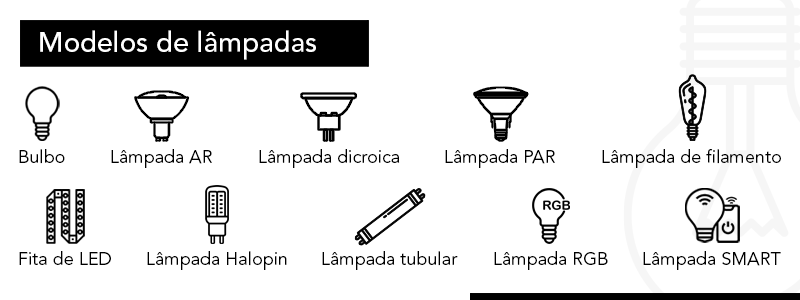
Bulb
The classic round lamp. One of the most popular, the bulb lamp is versatile and can be used in various luminaire models.
The most common use of the bulb lamp is in indoor environments, mainly in ceiling luminaires, table lamps, and bedside lamps.
Normally associated with the incandescent type, it is also possible to find this model in LED.
AR lamp
This type of lamp provides a concentrated light beam, which reduces glare. It also does not heat up or emit ultraviolet radiation.
Therefore, it is widely used in ceiling luminaires or spots, mainly for decorating or highlighting objects.
Dichroic lamp
It is one of the most widely used, as it does not generate as much heat and, therefore, does not damage the objects in the environment.
The conventional model, with reflectors, filters ultraviolet and infrared rays, protecting potential light and heat-sensitive objects, such as paintings and artworks.
PAR lamp
The PAR lamp can be applied in almost all environments, and is widely used in the most sophisticated highlight lighting.
This lamp model emits light rays that reflect brightness uniformly, making it ideal for environments with punctual luminous fluxes, such as stores, hotels, restaurants, and supermarkets.
Filament lamp
Normally associated with the incandescent type, the filament lamp is also present today in LED. In addition to conferring a retro design to the environment, this model offers greater durability and emits more light with less energy.
Another differentiator is that LED does not emit infrared or ultraviolet rays. Therefore, it prevents decorative objects from fading over time.
LED strip
Manufactured in a flexible strip format, the LED strip has a soft, indirect light, which favors its use to highlight decoration points.
Therefore, it is widely used in homes, to create depth behind mirrors and highlight shelves and cabinets.
Some models even have smart technology, allowing the use of a remote control.
Halopin lamp
Also known as "bi-pin," this type of lamp has two pins on the back. It is only necessary to connect them to start working.
Despite being small and discreet, their 360º light emission allows the illumination to reach a larger area with fewer lamps.
Combined with their resistance to temperature changes and weather events like rain, this characteristic makes them ideal for outdoor areas, such as gardens and facades.
Tubular lamp
With a high luminous flux and an elongated format, the tubular lamp ensures broader illumination.
It can provide the same amount of light as several smaller lamps, which can generate an energy consumption reduction of up to 60%.
Precisely due to its size and efficiency, it is widely used in commercial areas, industries, and corporate environments, larger spaces that demand a greater amount of light.
RGB lamp
RGB designates the colors red, green, and blue. This lamp, therefore, has three encapsulated LEDs, one in each of these colors. By mixing them, it is possible to create any color in the visible spectrum.
They usually come with a device that allows you to control the colors, intensity, and effects.
Its use is closely associated with decorative lighting, especially in parties. It is also used in nighttime pool lighting and even on Christmas trees.
SMART lamp
Connected to Wi-Fi networks, SMART lamps allow people to control functions such as turning on and off, in addition to changing colors, temperature, and even brightness. All of this is done by remote devices, such as an app on a cell phone or tablet.
Thus, it is possible to turn off lights forgotten on at home even if you are already on your way to work, for example.
What is the ideal type of luminaire for each need and situation?
Ceiling, floor, built-in, or surface-mounted: there are various types of luminaires available on the market. Understand which is the most suitable for your project!
Ceiling luminaire
This type of luminaire, which provides lighting originating from the top of the environment, can serve many functions.
With its use, it is possible to delimit areas in the same location, highlight objects or spaces, and create feelings of coziness or focus.
When hung from the ceiling at a height where it can be noticed, they are called pendants. A chandelier, for example, is a type of pendant.
The ceiling luminaires can also be plafons (built-in or surface-mounted), pendants, or spots.
Floor luminaire
The floor luminaire is also known as a floor lamp (column). This type of luminaire is practical, as it does not require a table or other type of support furniture. This makes it easy to be transported around the house without major difficulties.
The column can add sophistication, comfort, and intimacy to the environment, as happens with the Fuchsia model by Accord.
Table luminaire
The table luminaire can serve different purposes. There is a big difference, after all, between a bedside lamp used for reading at the end of a long day and a luminaire used during study time.
When it emits a directed beam of light, the table lamp helps in activities that require concentration, such as studying or working. In this case, lamps with a cool color temperature are ideal.
On the other hand, if the goal is to relax after a long and tiring day, the lampshade with diffuse or indirect light is the best option. The most recommended lamp is the one that has a warm color temperature, since the sensation transmitted is coziness and comfort to the eyes.
Surface-mounted plafon
The surface-mounted plafon has its body mostly below the ceiling line, instead of built into the lining.
With this type of luminaire, it is possible to enhance its shape, since it is evident, below the ceiling structure. Thus, unique designs and formats can stand out in the decoration.
Built-in plafon
Another way to use the plafon is built-in. The built-in luminaire is especially interesting for those planning a more minimalist environment, as the luminaire structure does not appear in the decoration.
To install this luminaire, it is necessary to make a cutout in a lining made of material that allows this interference, such as plaster, and position the plafon flush with the ceiling surface. Therefore, the object draws less attention, and the light gets all the prominence.
Tracks and spots
A spot is a small luminaire with directional light, used to highlight certain points of an environment, for example.
With the option of installing it alone or on tracks, you can use it to focus on just one object present in the environment, or even multiple points in the same area.
Pendants
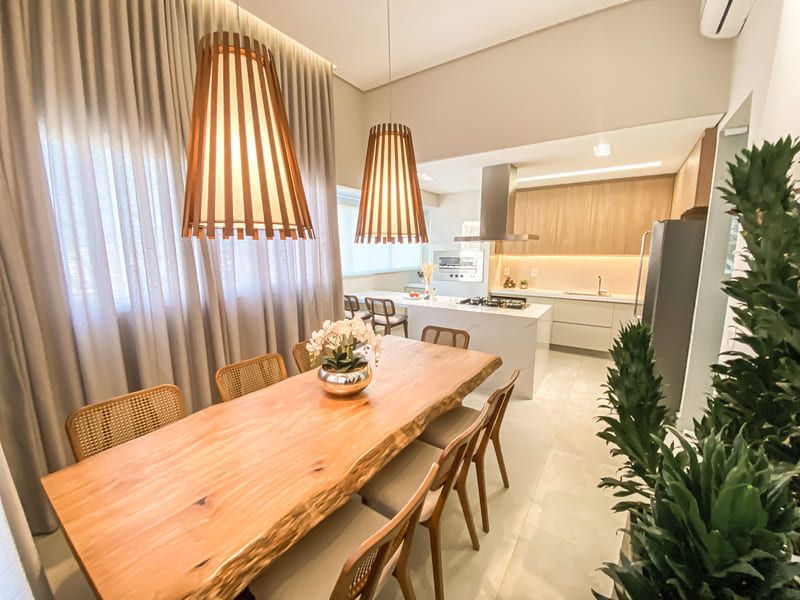
The pendant luminaires are those that are away from the ceiling, suspended and hanging, like the chandelier, for example.
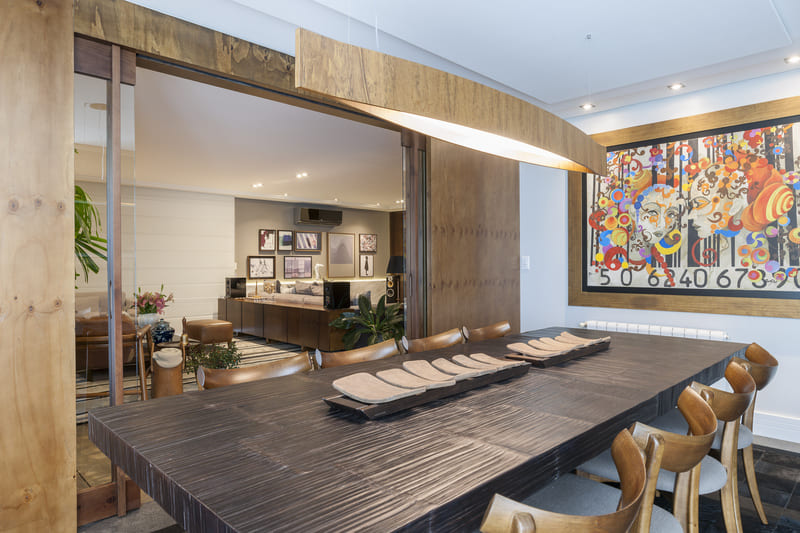
In open-concept living and dining rooms, pendant luminaires can serve to delimit the dining area from the rest of the space.
It is important to consider, however, that this type of luminaire receives more prominence in a space. Therefore, more care is needed so that the object is in harmony with the rest of the environment.
In the dining room, its positioning well above the table creates a light focus on this furniture. A pendant with an organic design can bring more fluidity and sophistication to the dining space, such as the Canoa luminaire.
Lampshade
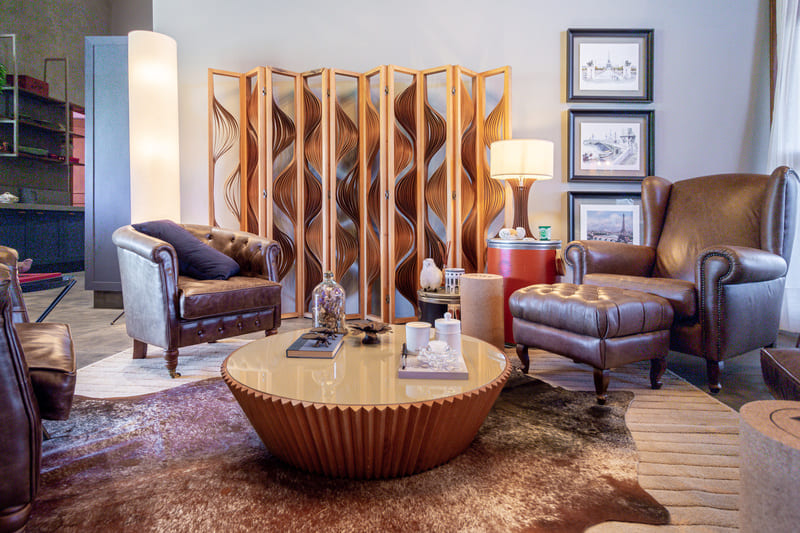
Perfect for moments of pleasure and relaxation, the lampshade has a diffuse light that provides visual comfort. This makes the object a good choice for lighting the living room or bedroom.
For study or work environments, which require greater concentration, the ideal is to opt for a luminaire with direct light, which helps create this type of environment.
Beacon (Path light)
The beacon is a lighting spot designed to indicate a path or a walkway.
It is widely used in outdoor environments, such as the pool, garden, or garage. However, it can also be present inside the house, in a hallway or on a flight of stairs, for example.
Sconce (Wall lamp)
The lighting of an environment does not need to be located only in a central luminaire and, in this sense, the sconce works very well.
Found in the most diverse designs, formats, and colors, it hangs on the wall and aims to act as complementary lighting, which can work as support or background for other light points.
After all, the sconce serves as a beautiful luminaire option to compose the room's decoration. With a diffuse and soft light, it brings a feeling of comfort and elegance.
Types of lighting for a project
Direct, indirect, diffuse, or accent lighting? Understand the main differences between them and how this can influence your project!
Direct lighting
If the goal is to provide a place with greater focus, betting on direct lighting may be the solution.
Directed straight at the environment, it draws the eyes' attention, and can highlight spaces in the house, with the use of spots or pendants.
In residential decoration, they are present in areas where tasks are performed with more attention to detail.
It can be in the kitchen, where it is necessary to see the food, in offices where there is a lot of reading, or even in beauty and care spaces, such as the bathroom.
Indirect lighting
In indirect lighting, the light is directed at a surface to then be reflected evenly throughout the environment, making it softer and visually more comfortable.
In an environment, it provides the sensation of comfort and a more intimate space, where it is pleasant to stay for longer.
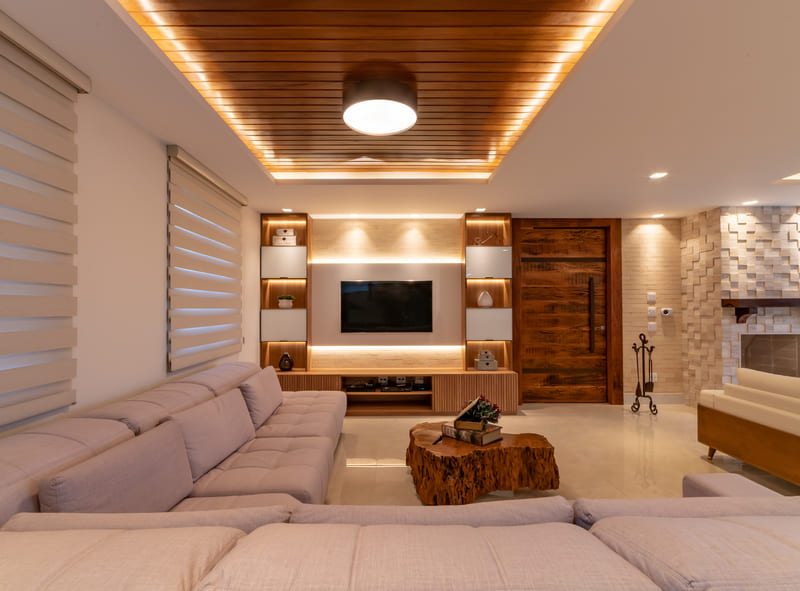
For this reason, it is indicated for long-stay places, such as the living room and bedroom. To implement this type of lighting, it is possible to use plafons, spots, sconces, or LED strips.
Diffuse lighting
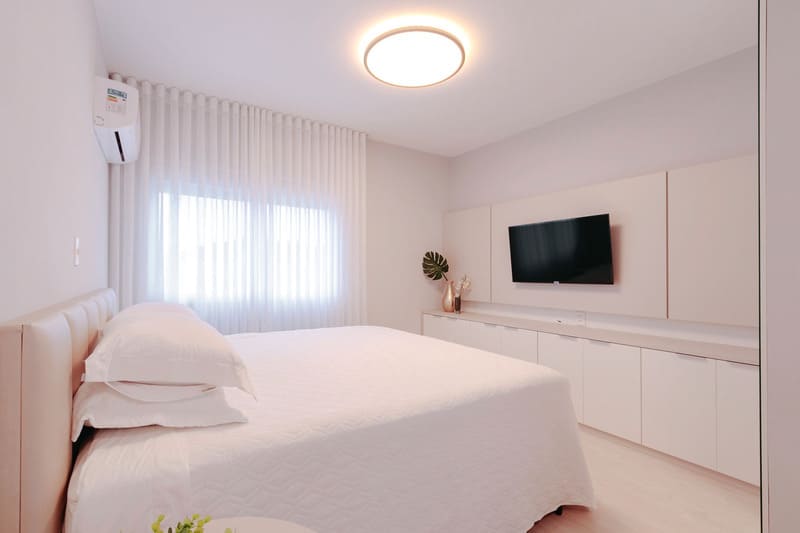
If you want to create lighting with less shadow, more uniform, and visually more pleasant, use luminaires that provide diffuse lighting.
Diffuse lighting can come from built-in luminaires, chandeliers, plafons, lampshades, or even sconces, depending on the chosen model.
The secret here lies in a filter present in the luminaire, usually made of glass or acrylic. It serves to block part of the light and produce the effect of diffuse lighting.
Accent lighting
This type of lighting can be the best option to highlight that painting hung on the living room wall, or an object that seems forgotten in the middle of the decoration.
Accent lighting, as the name implies, gives importance to an object or point in the environment that deserves that special attention.
In addition to using spots, you can create this effect with LED strips around furniture, on bookshelves, or in other places you want to stand out.
How does light temperature influence the lighting choice?
The light temperature of a lamp is related to the light's appearance, that is, whether its color will be warm or cool.
This is very relevant in a lighting project, as colors transmit sensations and can even induce behaviors.
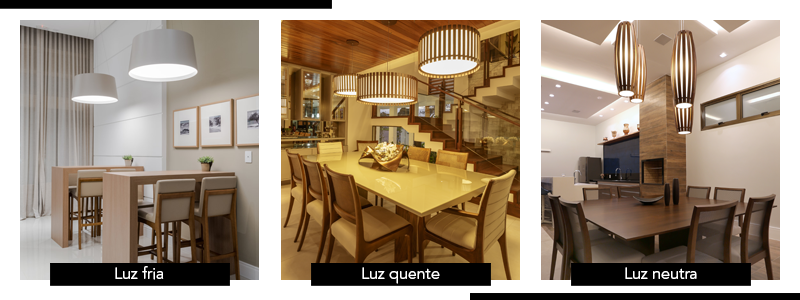
Warm lights, for example, usually make the environment cozier, while cool lights bring greater focus and concentration.
This temperature is measured in Kelvin degrees (K), and usually varies from 1,000 K to 10,000 K in lamps. In residential environments, it is most common for them to be on a scale of 2,700 K to 6,500 K.
There is no rule, however, on which color temperature to use in each room. It is important to evaluate how it will be occupied and what feeling you want to convey with your choice.
Remember that it is also possible to combine different temperatures in the same space. A bedroom with cozier lighting can have, for example, a luminaire with cooler tones on the study desk.
Cool light
Most used in environments that require greater visibility, cool light induces focus and concentration, with levels ranging between 6,000 and 6,500K.
Therefore, it is recommended for more intense workspaces or where there is a need to see better. This is the case, for example, with the kitchen counter or offices and study areas.
Warm light
Warm light induces relaxation, as it is more comfortable for the eyes and provides rest for the sight. The most used levels for warm light temperature vary between 2,700 and 3,500K.
It is recommended for cozier and long-stay spaces, intimate or social. It applies, for example, to bedrooms and living rooms.
How to define the best lighting for each environment?
Each space in the house is used for a function and thus requires different lighting. The office, for example, is a place of concentration, while the bedroom is used for relaxing.
However, defining the best lighting for each situation involves the user's experience in that specific location. Below, we present some light composition suggestions:
Read also: Game room lighting: 5 important tips
Living room
Usually, the living room is a space where you seek coziness and comfort. In this case, indirect lighting is a good ally to compose a long-stay environment, especially if combined with warm lights.
If you often use the armchair to read, for example, why not create a reading corner with a lampshade or a floor lamp?
Dining room
When we think of a dining room, the dining table immediately comes to mind, the most important object in this space. Not surprisingly, the decoration usually emphasizes this important gathering place.
The same goes for lighting, which can highlight it with the help of chandeliers and other types of pendants.
Spots can also work to compose the room's lighting, especially if the table is rectangular and longer.
Another suggestion is to opt once again for lamps with a warm color temperature, which invite people to stay in the space.
Kitchen and laundry room
Household chores, such as preparing food and washing clothes, require greater attention and brightness to see what you are doing.
Therefore, lighting in the kitchen and laundry room should be more functional, and cool or neutral light can help convey this feeling.
Many people choose a pendant ceiling luminaire for these spaces, which can be a good option, especially if placed right above the kitchen counter, offering better brightness for the area.
Another option, however, is the use of the plafon, especially if your kitchen is larger or more elongated. This is because this type of luminaire distributes light better throughout the environment without tiring the eyes, which can provide a better experience for those cooking.
Bathroom
Considering the functionality of this space, a suggestion is the combination of different light sources.
If the mirror area is used for activities that require seeing details, such as applying makeup or shaving, it requires uniform lighting without shadows so you can see better.
For this, a good solution is the use of sconces or even LEDs that highlight mirrors and niches.
It is also possible that your bathroom has a bathtub. In that case, your goal for this place will be more focused on relaxation after long days.
Try, then, a diffuse and soft lighting that will bring that feeling of comfort. The plafon can be a good choice if used with neutral-colored lights.
Bedroom
So important in the house and in the residents' lives, the bedroom deserves special attention. After all, a good night's sleep can affect different aspects of a person's routine, from work to social relations.
To provide more welcoming lighting, bet on diffuse and indirect lights, with low color temperatures. This can be created with the use of the plafon, for example.
Lampshades and sconces can also be present here, fulfilling the function of complementary lighting. They are allies in the moment of reading and relaxing before finally falling asleep.
Many people, however, also use the bedroom for studies or as an office. In this case, mixing lighting types can be a solution, and it is even possible to consider a pendant luminaire in the desk area.
Office
You need to be awake and attentive in this space of the house, where users usually spend many hours of their day. For this, bet on direct lighting and neutral lights, which offer greater visual comfort and stimulate concentration without tiring the eyes.
It is recommended to position the light focus right above the work desk, for a simple reason: if the light comes from behind you, as can happen if you have a pendant luminaire located in the center of the room, it can cast a shadow and disrupt your activities.
A good option for this environment is to have a pendant luminaire over the table or even LED strips to light shelves and bookcases.
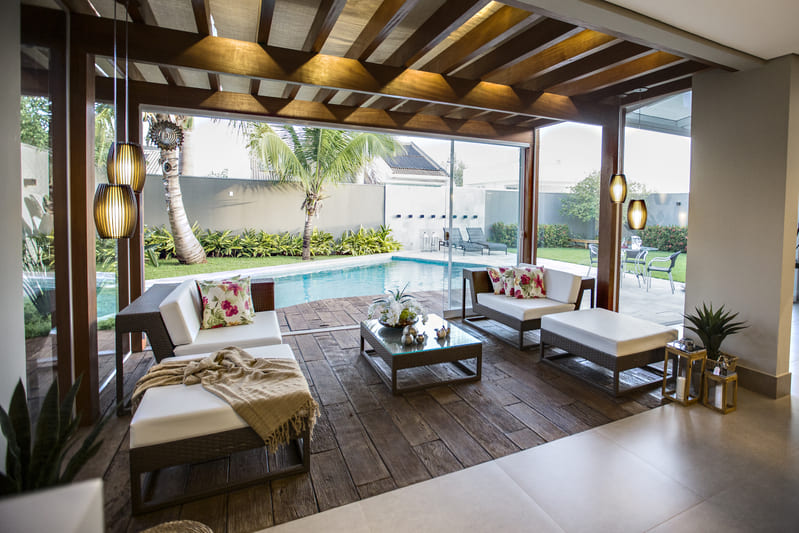
Outdoor area
If a well-kept garden already guarantees a different look for a house, this can be enhanced with the help of good lighting.
In this case, play with outdoor lights. Try placing luminaires among the plants to enhance shrubs and trees; use spots, sconces, and reflectors to create a play of light and shadows.
In the case of the facade, safety is an extra factor to bet on good lighting. Positioning sconces next to the entrance door ensures greater visibility for residents, and can contribute to the peace of mind of those arriving at night.
If there is a path leading to the door, it must also be lit. For this, try floor-recessed spots.
Balcony and gourmet area
Good lighting on the balcony or gourmet area can be a decisive factor in keeping guests animated and for much longer in this special corner.
In cases of outdoor environments, try using spots to highlight coverings and plants, or even outdoor sconces in the lighting composition.
If you have counters, grills, and tables, especially on balconies, you can invest in a good pendant luminaire. It will highlight the gathering area, calling people to the meeting.
Tips to create a lighting project suitable for each situation
Now that you know the different types of lamps, luminaires, and lighting, it's time to put your project into practice! Check out some extra tips to make it even more special:
Consider sustainability and energy savings
A lighting project with high energy consumption is something that should be avoided. In addition to making the electricity bill more expensive and causing harm to the environment, it can be less pleasant for the house's residents.
Natural light should be a priority. Besides being more pleasant, it makes your project more sustainable in the long term.
The solution is simple: make use of the wide spaces you have available, in addition to doors and windows.
Also, opt for LED lamps, which are more economical, require fewer replacements, and are safer.
Make a survey of the points that need to be lit
Those who stay at home a lot know that point that was forgotten during the decoration. It could be a poorly lit kitchen counter, the back of a closet where light doesn't reach, or a reading corner without a lampshade.
To ensure your living is as pleasant as possible, note down the places that need lighting, including those that go unnoticed in a larger project. This makes all the difference in everyday life.
Combine the luminaires with the decoration project
Luminaires can be built-in and discreet in the decoration project, drawing more attention to the light.
However, they can also be a standout object in the decoration. If the project is not well thought out, the luminaire can end up clashing with the rest of the environment, causing strangeness or discomfort to the user of the space.
Understand the decoration style you are looking for and seek to harmonize the furniture with the luminaires and the space's functionality, always respecting the user's experiences and preferences.
Make your project unique and functional with Accord luminaires!
Accord can help you with your lighting project. For over 25 years, the company has worked with the sophisticated and contemporary design of decorative wooden lighting fixtures.
Accord's products, besides having an innovative design, use the best in terms of raw materials, translating into products of unique quality, durable, and reliable.
Discover the luminaire models, such as pendants, plafons, sconces, lampshades, and floor lamps, which combine crafting techniques with the highest technology and make your home even more special!
Comments (0)
No comments yet. Be the first to share your thoughts!
Leave your comment
Your email will not be published. All comments are moderated before being posted.


