
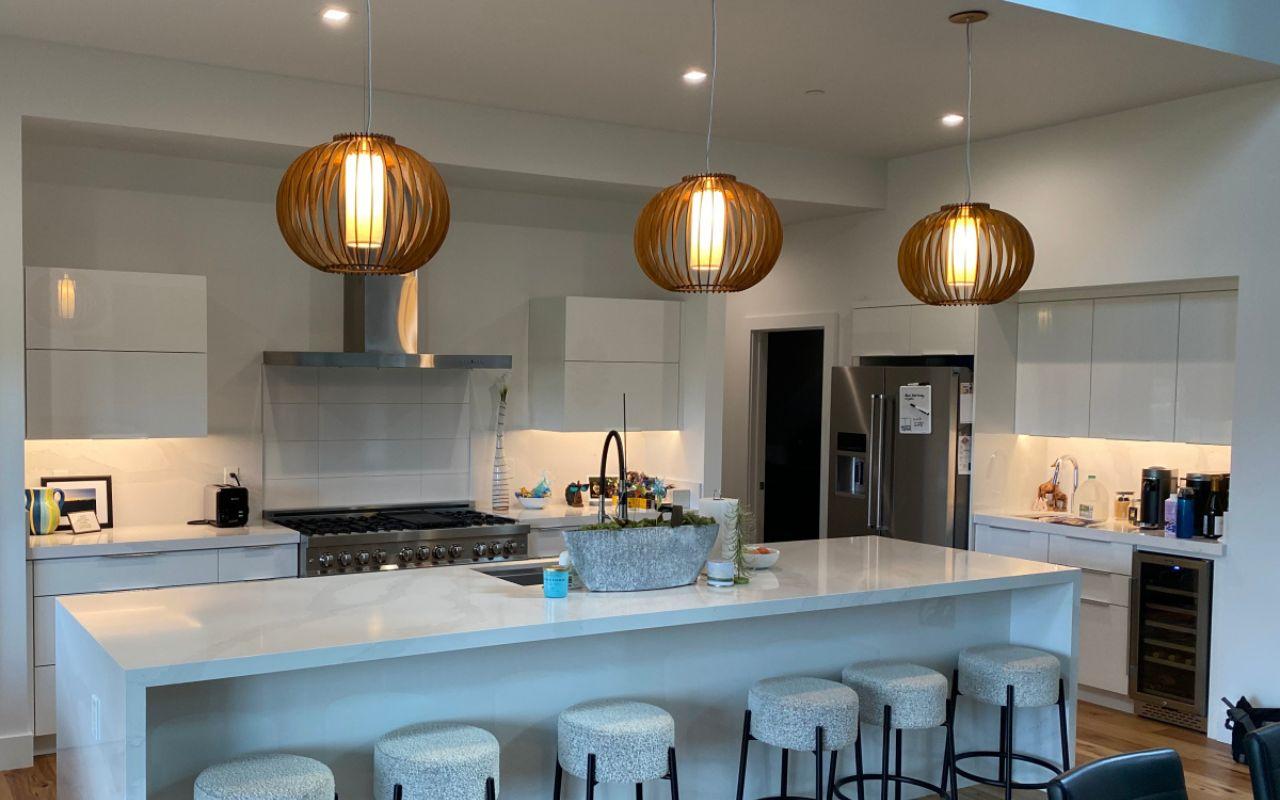
You, who transform spaces with your talent and creativity, know how lighting is the magic key that enhances every detail. And the choice of the kitchen luminaire makes this challenge even more specific.
After all, the purpose of light here is not just functional, but a form of expression to elevate the environment. A wrong decision can turn the food preparation space into a zone of shadows or, worse, a place prone to accidents.
Let's explore how the right luminaires can be the perfect touch that makes all the difference for the kitchen!
Kitchen luminaire: the relevance of having adequate lighting in the space
Light is an essential ingredient for functionality and well-being in the heart of any home. Firstly, because an efficient lighting project eliminates shadows and facilitates handling food, preparing recipes and other daily tasks.
Furthermore, the ideal luminaire transforms the kitchen into an inviting space. Warm tones, for example, create a welcoming atmosphere, perfect for meals and special moments.
Not to mention that well-distributed light focuses reduce the risk of accidents and can give an extra highlight to the details of the room's design.
So, remember that you are facing a setting for daily meals, special gatherings, and shared moments. For this very reason, good lighting is the recipe for a truly inspiring and versatile kitchen for each of these situations.
Main types of luminaires to use in the kitchen
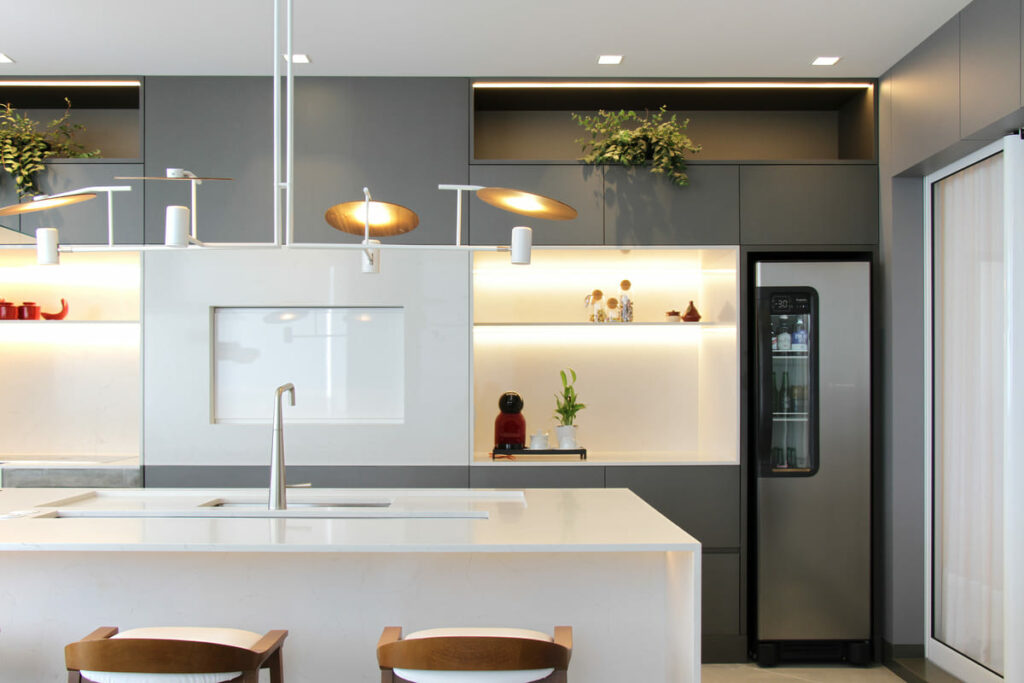
To illuminate every corner of the kitchen with style and functionality, it is essential to know the main types of luminaires. Each one is a unique piece that offers light, personality, and style to the space. Let's explore some of them:
Plafon
Designed for a uniform light distribution, the plafon is quite versatile and matches both minimalist designs and elaborate projects to create ambient light, perfect for kitchens in general.
As an example, imagine a plafon in the center of the kitchen to illuminate the entire area and allow all locations, furniture, and necessary utensils to be visible.
Pendant
Suspended from the ceiling, the pendant can add a decorative touch to the lighting. And the interesting thing is that it can be found in a wide variety of styles and sizes to suit every kitchen.
Furthermore, the charm of a pendant over an island kitchen is undeniable. This centralized luminaire can add a complementary touch of functionality and elegance to the space.
Sconce
In turn, the sconce is fixed to the wall, which usually saves space and composes a unique aesthetic to direct soft beams of light.
Luminaires for small kitchens: maximizing space and style
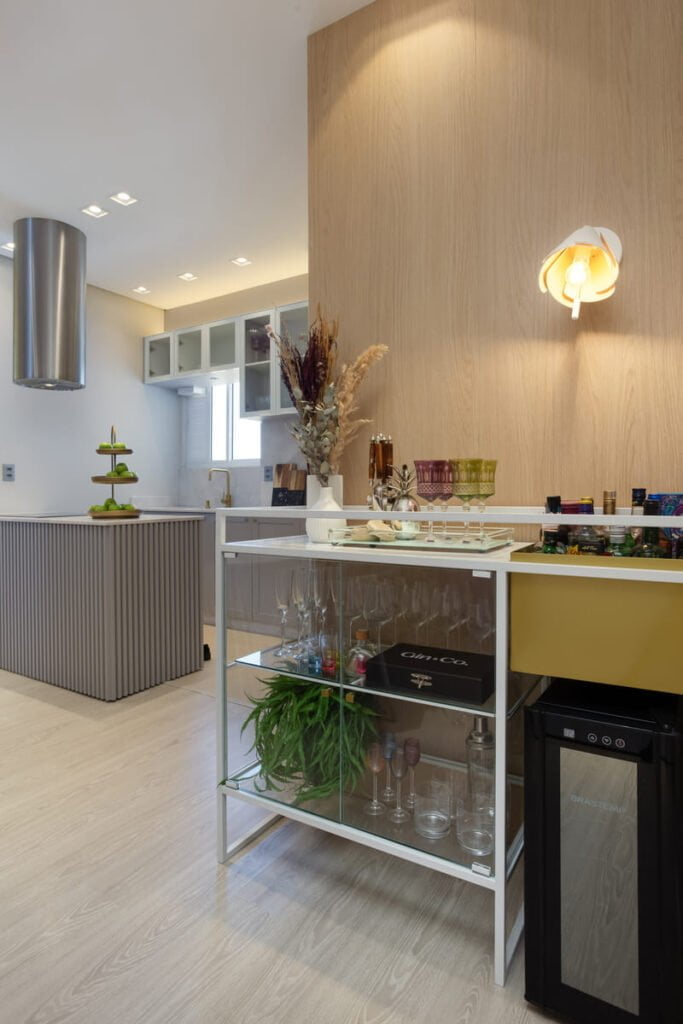
There are many decoration possibilities with luminaires for small kitchens, did you know? Many people fear that the limited space is an obstacle, but this is far from true. Check out some creative inspirations to compose the environment:
- Pendants over the counter or dining table can direct light to specific areas, and compact models help optimize space;
- Plafons or recessed luminaires maximize vertical space — and minimalist designs do not visually overload the area;
- Recessed luminaires in specific areas, such as upper cabinets, provide focused light;
- Indirect lighting in niches or shelves brings softness without taking up space;
- Luminaires with cold and neutral tones contribute to a feeling of expansion;
- Luminaires close to mirrors reflect light and visually enlarge the space.
Also, remember that natural light is a great ally when illuminating environments. Allow it to enter to keep the room as bright as possible throughout the day.
Luminaire for an open-concept kitchen: combining functionality and aesthetics
The open-concept kitchen (American kitchen), with its open design that integrates spaces, is an invitation for conviviality and sociability. Hence, the importance of choosing the right luminaires to highlight this dynamic environment.
Let's explore tips and examples to choose the products that best help enhance the beauty of this kitchen style:
- Pendants over the counter or over the island create a focal point and highlight the food preparation area;
- Linear luminaires, such as track lights or LED strips, visually run along the length of the kitchen and provide an even distribution of light — ideal for open spaces;
- Plafons for wider areas of the open kitchen create efficient general lighting;
- Recessed luminaires can be used to create light points in specific areas, without obstructing the general view or taking up space.
There are plenty of options, right? Just be careful to balance the idea of functionality and style to accentuate all the elegance of the open kitchen.
Read also: Task lighting: 5 ways to use it best
How to choose the best type of kitchen luminaire?
When it comes to illuminating the kitchen, the choice of luminaire is vital to create a functional and aesthetically pleasing environment. Consider these tips when selecting the ideal luminaire for your kitchen:
Project design
Choosing a luminaire whose design harmonizes with the general aesthetics of the kitchen can favor a greater integration in the decoration.
Consider finishes and materials that complement existing elements.
Proportional size
Adjust the size of the luminaire according to the dimensions of the kitchen. Avoid pieces that are too large or too small to find a good visual balance.
Strategic positioning
In kitchens with islands or peninsulas, pendants add focus and style. Meanwhile, the plafon can be ideal to evenly distribute light in kitchens with a wider layout.
Multifunctional environments
If the kitchen in your project is a multifunctional space, adjust the light intensity or opt for versatile luminaires that adapt to different activities.
Consider elements with adjustable designs to direct the light as needed.
Installation and positioning of kitchen luminaires
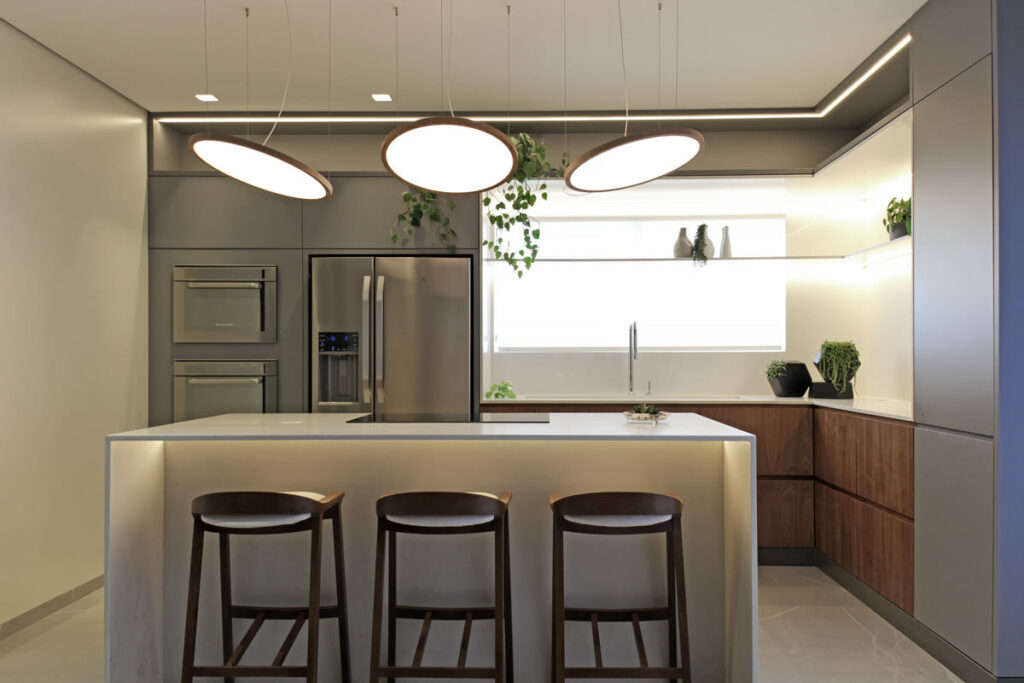
When installing kitchen luminaires, strategic positioning must guarantee efficient lighting and pleasant aesthetics. To do this, consider:
- Position the pendants at a height of approximately 75 to 90 cm from the countertop;
- Create light uniformity for recessed luminaires. To do this, distribute them evenly throughout the room;
- Use directional luminaires (like sconces, for example) to highlight specific areas, such as a collection of utensils.
Just pay attention to the formation of shadows. Avoid kitchen luminaires creating unwanted shadows. Install them in a way to maximize functional lighting.
Based on these guidelines, you should be able to efficiently illuminate the kitchen, but it is possible to go further: you will enhance the aesthetics of the place, give the desired personality to the project and make the kitchen a functional and visually pleasing space.
Get the best out of every kitchen luminaire with Accord!
In every recommendation on kitchen lighting, we seek, through this text, to show you the importance of maintaining the balance between functionality and style.
This makes it easier to analyze the strategic positioning of each luminaire and pay due attention to the details to transform the space into an environment that goes beyond utilitarian.
The correct height of the pendants, the uniformity of the light, the attention to natural light and the adaptation to the specific layout of the room are considerations that will make all the difference in the result.
And, by personalizing the choice of each kitchen luminaire according to its size, style and environment needs, you create a bright, practical environment with excellent aesthetic appeal.
Remember that the kitchen is more than just a place to prepare food: it is a central point of coexistence. By following our tips, you will certainly develop enchanting projects!
If you need more tips, inspiration and suitable models of kitchen luminaires, check out the Accord website!
Comments (0)
No comments yet. Be the first to share your thoughts!
Leave your comment
Your email will not be published. All comments are moderated before being posted.


